
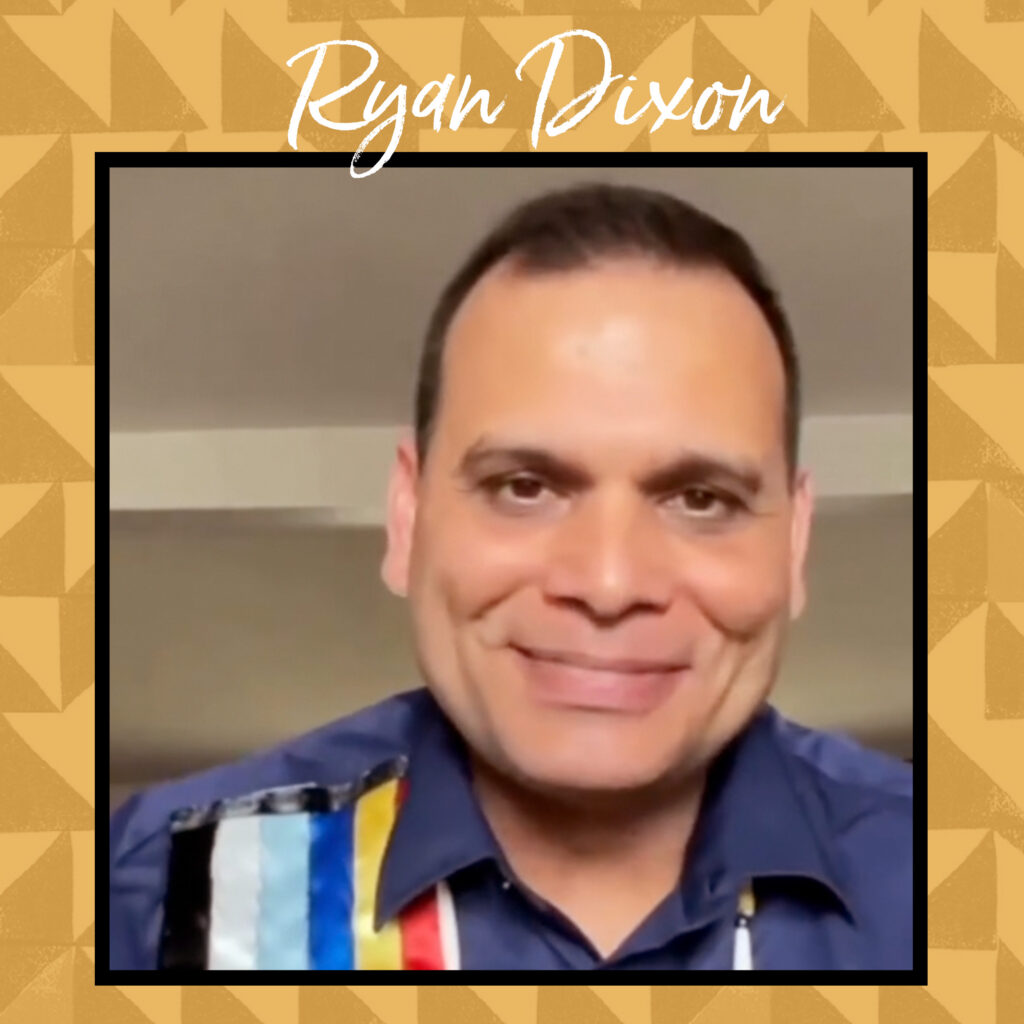
Today, we’re speaking with Ryan Dixon. Ryan is an enrolled member of the Oglala Lakota Tribe from Pine Ridge in South Dakota and has spent over two decades immersed in the Lower Sioux community in southern Minnesota. He trained under First Language Dakota speakers, and he now teaches Dakota. An educator and Indigenous language activist, he co-founded a Dakota Immersion Head Start programming and works to keep the language alive for future generations.
Ryan grew up in Georgia, far away from the Lakota homelands, but he had access to a first language speaker in his grandmother. When he moved to the Lower Sioux community in Southern Minnesota, he was recognized as someone who knew a little language. That led to people asking him to translate and, later, to an unbelievable apprenticeship that paid him to learn and teach Dakota. He didn’t speak fluently until he was 31 and believes anyone can gain fluency in two years. But he says there’s one key ingredient that can’t be missing if a language learner wants to succeed. He also shares how he connects to the spirit of the Dakota language and what it means to become its friend.
—–
Hosts / Producers: Leah Lemm, Cole Premo
Editor: Britt Aamodt
Editorial support: Emily Krumberger
Mixing & mastering: Chris Harwood
Native Lights is produced by Minnesota Native News and AMPERS with support from the Minnesota Arts and Cultural Heritage Fund.
—–
For the latest episode drops and updates, follow us on social media.
Never miss a beat. Sign up for our email list to receive news, updates and content releases from AMPERS. ampers.org/about-ampers/staytuned/
This show is made possible by community support. Due to cuts in federal funding, the community radio you love is at risk. Your support is needed now more than ever. Donate now to power the community programs you love: ampers.org/fund
TRANSCRIPT
[Music: Native Lights Theme]
RYAN DIXON: I had a teacher, a man by the name of Waƞbdi Wapaha, Glenn Wasicuna, from Sioux Valley, Canada, and I spent about a year with him, maybe a little more. And he taught me a lot about the language. He taught me, you know, the language is alive, the language is sacred, why it’s sacred, and he taught me that, you know, make a friendship with the language, and I did that. I wouldn’t say it came easy to me, but I would just say I had the want.
LEAH LEMM: Boozhoo, hello, welcome to Native Lights, where Indigenous voices shine. I’m your host Leah Lemm.
COLE PREMO: And I’m your other host, Cole Premo. Miigwech for joining us. Native Lights is more than a podcast and radio show. At its core, it’s place for Native folks to tell their stories, each and every week we have captivating conversations with great guests from a whole lot of different backgrounds, like musicians, artists, doctors, educators, language warriors-you name it. They have a wonderful mixture of passions, and we talk to them about their gifts and how they share those gifts with their community. And it all centers around the big point of purpose in our lives, and I cannot wait to continue amplifying Native voices today. Leah, what’s going on?
LEAH LEMM: Oh, not too much, just hanging in there. How about you?
COLE PREMO: Same, same, same, same. Trying to get sleep. Trying to get sleep.
LEAH LEMM: Yeah.
COLE PREMO: Sometimes successful, sometimes not.
LEAH LEMM: Oh, sleep.
COLE PREMO: Taking naps when they come.
LEAH LEMM: Yeah, yeah, I know that’s tough, but…
COLE PREMO: Yeah.
LEAH LEMM: You know we persevere. The time flies, and then all of a sudden, he’s nearly six feet tall, and yeah.
COLE PREMO: Jeez.
LEAH LEMM: So.
COLE PREMO: Yeah, well, let’s get into it, huh?
LEAH LEMM: Yeah, let’s do it. So today we’re very excited to speak with Ryan Dixon. Ryan Dixon is an enrolled member of the Oglala Lakota Tribe from Pine Ridge in South Dakota and has spent over two decades immersed in the Lower Sioux community in southern Minnesota. And he trained under First Language Dakota speakers, and he now teaches Dakota. And he co-founded a Dakota Immersion Head Start programming works to keep the language alive for future generations. Let’s welcome Ryan Dixon. Boozhoo, Ryan.
RYAN DIXON: Hi.
COLE PREMO: Howdy, Ryan. Thanks for your time. Thanks for your time.
RYAN DIXON: How are you?
LEAH LEMM: Good. It’s nice to see you.
COLE PREMO: Yeah, Ryan. Could you please start by introducing yourself and you know letting us know where you’re joining us from?
RYAN DIXON: [Speaks in Lakota/Dakota.] So whoever is sitting listening, I’d like to say thank you. [Speaks in Lakota/Dakota.] So my name is Ryan Dixon. My Dakota or Lakota name is Wild Thunder Horse. I am coming to you from Caŋṡa’yapi, where they mark the trees red, also known as the Lower Sioux Indian Community in Southwest Minnesota. When you think of Minnesota, you think of lakes. It’s not going on here. We are surrounded by cornfields.
COLE PREMO: How are you doing? And how’s the family doing?
RYAN DIXON: Everybody’s great. I have a daughter at the University of North Dakota. She is currently a junior. She’s getting into public health. She intends to get her Master’s and also major in Dakota language. I have a daughter at Augsburg University. She’s a freshman, basically playing basketball. My oldest daughter has two wonderful children, with a third on the way. Everybody’s healthy and happy, so couldn’t ask for more.
LEAH LEMM: Wonderful. Well, Ryan, what are you thinking about these days? Is there anything that you are, I don’t know, kicking around or obsessed with? I just gotta say, I just binged Ted Lasso, and that was wonderful. But that’s just me. How about you?
RYAN DIXON: I don’t do a whole lot on the weekends. I kind of just you know stay on the couch. I was born in Georgia, so I’ve always been a huge Georgia Bulldog fan. But being you know a student of the University of Minnesota, I also follow them. I don’t have a whole lot going on. I stay busy with my tȟakóža, my grandchildren. I have a two-year-old grandson, a one-year-old granddaughter. A lot of football. I’ve probably jumped on a trampoline more in the last month ever in my whole life. I may grow to regret purchasing the trampoline.
LEAH LEMM: Here, that’s supposed to be good for you. A little dangerous, but can be good for you.
RYAN DIXON: Yeah, when you’re when you’re almost 45, is just the spine moves a little differently.
LEAH LEMM: Well, Ryan, then we are the same age, and yeah, I could probably see that. So I gotcha, I gotcha.
COLE PREMO: I’m sorry, but I remember when I was growing up that if there was a person that had a trans. In the neighborhood, we’d all crowd to that person’s trampoline. Does that happen to you?
RYAN DIXON: I mean, it used to like when I was 12-13, You know, we used to always have like Royal Rumbles. My grandson, I had to cut him off from WWE. I let him watch at one time, and he got a little too rough with his sister.
LEAH LEMM: On the trampoline?
RYAN DIXON: Yeah, but you know he gets his practice on me. I’ll let him be rough with me.
LEAH LEMM: I think we used to do that, Cole. We are siblings, by the way. I don’t know if we mentioned that.
RYAN DIXON: Oh no, I didn’t know that.
LEAH LEMM: No, okay. Just out of nowhere, like we used to do that. We used to pretend fight slash real fight.
RYAN DIXON: Oh yeah.
LEAH LEMM: That’s the best part about growing up. Oh yeah.
COLE PREMO: You’re listening to Native Lights, where Indigenous voices shine. Native Lights is produced by Minnesota Native News and AMPERS with support from the Minnesota Arts and Cultural Heritage Fund. Today we’re speaking with Ryan Dixon, an educator and Indigenous language activist who has taught and coached the Dakota language since 2012. He’s an enrolled member of the Oglala Lakota Nation in South Dakota and has lived in the Lower Sioux Indian Community in southern Minnesota for well over two decades.
LEAH LEMM: Cool. Well, Ryan, why don’t we jump in and kind of talk about you and your path? You dedicate your time to teaching language. Is 12- or 13-year-old Ryan surprised, or is he like, yeah, I thought I was gonna do that?
RYAN DIXON: You know, honestly, at the time, you know, I wasn’t living where I was exposed to a lot of language and culture. I was, I was living in Georgia. My grandfather had been in the military, and we got displaced that way. But my grandmother was a first language Lakota speaker. She is from Pine Ridge. Her parents were in their mid 40s when they had her. She grew up isolated area, so you know my family was able to you know hold on the language and ceremony and all that, so I was always conscious, which I’m thankful, that I was conscious of my grandmother spoke another language, and I always thought that was cool. And so my whole life, you know, I’d bug her. Hey, we say uŋčí. “Uŋčí, how do you say this? How do you say that?” And you know, kind of get on her nerves. You know, she’d be busy soap operas or whatever. But she would answer me. She’d think about it for a minute, and she would answer me, but she never like actively taught me. Like I was never conversational until I became 31. I’ve lived in the Lower Sioux community since I was about 23-ish, something like that. And people knew that I knew some language, and you know, my kids and some other friends would ask me, “Hey, how do you say this?” And a lot of times I could answer them, but sometimes I couldn’t. And I was approached by Grace Goldtooth. She worked at Dakota Wicohan at the time, and she’s like, “Hey, Ryan, we got an apprenticeship. You want to get paid to learn the language?” And thought about it, and I’m like, “Yeah, like I would, I would love to do that.” Well, I mean, why not? I mean, be able to teach my kids more language, you know. So I did that, and I was able to. My first year, I was kind of on my own, but the second year, I had a teacher, a man by the name of Waƞbdi Wapaha, Glenn Wasicuna, from Sioux Valley, Canada, and I spent about a year with him, maybe a little more, and he taught me a lot about the language. He taught me, you know, the language is alive, the language is sacred. Why it’s sacred. And he taught me that, you know, make a friendship with the language, and I did that. I wouldn’t say it came easy to me, but I would just say I had the want. A lot of times, you know, a lot of people they don’t really have that want. They want to learn the language, but they don’t really want to learn the language. They don’t want to put in any work. So I made plenty of mistakes along the way, but I just kept at it, and I was able to help the community here. I made that friendship with the language, and I do things for the language. And in return, the language you know, kind of takes care of me. Like I’ve, I’ve traveled all over the country, all over the world, and for the most part, that was due to the language. I don’t really go out and seek a lot of opportunities. I’m a pretty quiet guy, keeping to myself, but a lot of opportunities find me, and it’s because I believe it’s because of that friendship with the language, so I would say no, not really surprised. 12- or 13-year-old, he’s probably like, “Dude, why didn’t he do it earlier?”
LEAH LEMM: Isn’t that always the case? Sheesh, how do you make friends with the language?
RYAN DIXON: Through ceremony. It was taught to me that you know the language has a spirit. You know, you talk to it. You give thanks. You know, Dexilanny [?] always said, like, if you want to learn the language, you know, first you go to the creator and you ask, or you tell the creator, “Hey, I would like to learn the language. Would you allow me to do this?” If the creator sees that you’re fit, then you’re going to have an easier time. Learning the language, he drew this really cool triangle. One point in the corner to be me, the other point of the opposite corner to be the language, and up at the top would be the creator. And he said, you know, a lot of times, most of the time, we try to go straight to the language. We don’t go to the creator first. It’s always kind of you know kept those things in mind. Just try to always remain humble, and the language thought maybe I was okay to hang out with, so they’re still here.
COLE PREMO: I’m curious of how the want that you described for learning the language transition from that to teaching it to others, or did that always seem hand in hand for you?
RYAN DIXON: I always wanted to learn the language. Always wanted to speak more than I could. Had thought about being a teacher because I always had like I’m very passionate about history, you know, culture, things like that. But I kind of messed around and dropped out of college, and you know, it’s kind of before I found my way back with the language of back to school, and you know those things. As I apprenticed in the language, like from the start, I had to teach, and there were many bad nights where I made some pretty novice mistakes, but I did. I don’t know. I didn’t let it get me down, and I saw that you know my children were proud of me, and they had pride in language. I did kind of some mentorships with young Native men, teenage age, and all the pride that it brought to them once they started to learn language. So you know I wanted to share as much as I could you know from the elders one thing you know a value that I learned early on is silence is very important to listen and so my philosophy now is you know listen to the elders learn and then you know pass on what I’ve been fortunate enough to be a part of. I don’t feel like any of the teachings are me. I feel like I’m just absorbing as much as I can from the from the source from those elders. Because without them, I’m nothing, and I just kind of try to relay that on and relay the importance of you know why I do the work that I do.
LEAH LEMM: What else do you think it takes to be a good teacher? You know, you mentioned listening and learning, but how do you connect with the language learners?
RYAN DIXON: I always made sure when I taught high school, it was very important for me to speak to every student I had in class, and sometimes I had up to 20 kids. But I started out every day. I would ask them how they were doing. Always tried, you know, connect with them that way. Most of my students I was familiar with from the Lower Sioux Indian community, not a very big community, so I knew most of the kids, or if I didn’t know them, I knew their family. So I’d always have those conversations, you know, ask about a relative or maybe they had a hobby. I’d always try to talk about that with the language. Always try to make it fun, engaging, something they’re gonna use. Yeah, they bought into it.
LEAH LEMM: That’s wonderful. Do you feel like there’s any adaptations or adapting the language to students’ interests, or students like how do you say video games or something like that? That’s like maybe not in the language as far back.
RYAN DIXON: So things like that-a video game or a television, of course, we didn’t have until colonization, but it’s all every so often a group of speakers will get together and have a meeting, and they’ll go over words. And once there’s kind of like a consensus, they’ll create those new words. They call them neologisms, but the names for those modern things they can vary from community to community. It just kind of depends on how they described it at the time, but it is very important to do all those things, like to talk about incorporate sports, video games, watching movies, any of the hobbies they do, listening to music, and we talked about all those things.
COLE PREMO: The changes that you’ve seen in, you know, what’s possible for Dakota language work, you know, since you started. Maybe you know, grant funding has a role in that, but I’m just curious how you’ve seen that evolved?
RYAN DIXON: You know, when I started going on almost 14 years now, I’ve been involved in the language. There, there are more teachers nowadays, for sure. A lot more awareness. We’ve done a good job with that. You know, talk about the state of the language, the importance of the language. When I first started, you know, we didn’t have it in the schools, and now we have it in our area schools. You know, not every kid’s gonna buy into the language, but there are a handful in every class that the language is something very important to them, and they want to come and they want to work for our birth to five immersion school, and then our eventual K through four immersion school. You know, they’re proud of, and they want to continue growing the language in their community. Like I always told the kids, like I want you guys to put me out of a job. I want to be able to retire early, and you guys just take it over. Being that I’m not, I’ve lived in the community a long time, but I’m not technically from Caŋṡa’yapi. My wife and my children are, but it was always like it’s got to be people from the community who you know have these leadership positions, these teaching positions, if it’s going to take hold.
COLE PREMO: Do you have like a memorable experience with a student who like maybe they spoke a full sentence to you unprompted, or just you saw the fruits of your work?
RYAN DIXON: We used to travel to language bowls. We also host language bowls here in the community. When my daughter, she was like maybe eighth grade, seventh or eighth grade. Both my daughters competed, and they were you know way younger than the high schoolers they were going against, and you know they took it home. They took home the Harding High Language Bowl. We took home first and second. That was pretty early on in my teaching journey. It really boosted the confidence of a lot of kids. They weren’t quite sure. They knew they knew a lot of language, but you know once they bring home a trophy, that really helps.
LEAH LEMM: You want another one?
RYAN DIXON: Yep, one for you.
LEAH LEMM: Do you still compete?
RYAN DIXON: I took a new position. This will be my second year working for NISN [NACA Inspired Schools Network], so I’ve kind of stepped back from that. I don’t work in the Redwood Area School. I don’t take those kids, and I don’t think they actually went last year because they don’t have a language program now since I took my new position. If the kids want to do it, you know, I always say I’m like, hey, you know, come to the rec center. We can study. You know, I always support them. You know, if they want to be involved in those.
LEAH LEMM: What are the opportunities then for young people to continue learning the language after they’re graduated from working with you or working with the schools that you’re in?
RYAN DIXON: The area districts they’re really trying to build their language programs because it’s something the parents and the students have really been asking for a lot. So right now in the community, we just had the birth to five years of age, and then they transition into the other schools. They’re trying to add as much language as they can. One school has added middle school language, like maybe 20-30 minutes a day, and then they also have the high school class. Whereas the other one, they’re trying to fill those positions, but there’s not many licensed Dakota language teachers in the state. We do after school, the recreation center, at least one day a week. We host three to four other classes in the evening. So yeah, we try to give people no more excuses. Like we try to do as much as we can.
LEAH LEMM: And then licensing to become a teacher in the Dakota language. Is there a different process, or what oversight is that?
RYAN DIXON: How I got in something called eminence credentials. So the tribe believed Dakota Wicohan nonprofit, and then I had an elder or two sign off saying that I was a proficient speaker and I knew what I was talking about. Now I think it’s a little more strict, but I’ve been licensed for I don’t know, 10 years or so. I think there’s only like maybe two or three in the entire state that are licensed, and we are currently, we’re creating a pathway. We’re working with Bemidji State, and we’re trying to create a pathway to be able to certify our own teachers.
LEAH LEMM: Yeah, I imagine that’s kind of one of those things that, like who licenses whom. Interesting. I would imagine that the elders would be kind of strict.
RYAN DIXON: So the state of South Dakota, they have an actual test that you have to take, but Minnesota, as far as I know, there that does not exist.
LEAH LEMM: You are listening to Native Lights, where Indigenous voices shine. Native Lights is produced by Minnesota Native News and AMPERS with support from the Minnesota Arts and Cultural Heritage Fund. Today we’re speaking with Ryan Dixon. Ryan’s an educator and Indigenous language activist. He’s been teaching and coaching the Dakota language since 2012, and Ryan is from the Oglala La. Dakota tribe in South Dakota and lived in the Lower Sioux Indian community in southern Minnesota for well over two decades.
COLE PREMO: You may have touched on a little bit, but just the Dakota Immersion School. Can you talk about how that formed? What was the spark for that, and where is it at now?
RYAN DIXON: I believe we opened in 2018. It was. kind of like a pipe dream. We had seen things about immersion schools and like, yeah, that’s the that’s the way to do it. Vanessa [Goodthunder] and I and Grace [Goldtooth], we were all considered advanced speakers. Our grant writer at the time, Nora Murphy, she’s like, “Hey, we can try out for this?” And she wrote the grant, and lo and behold, we got it. And the first couple years, it really takes a lot of work, a lot of planning to create a successful immersion school. And in the community, like we don’t have any first language speakers. There’s only four of us that are at the advanced, superior rating or whatever. So we had to create a lot of our own speakers, and we had less than a year to do all this. For so for first couple years, we were just kind of treading water, and things get better, and then you know you have you spend you dedicate time teaching somebody the language, and then they go work somewhere else, or especially like after COVID, like I saw this slide in my high school work too. A lot of people decided that they didn’t want to be teachers anymore, and so we kind of had to start over. But things are good. We have an apprenticeship for some of our workers. I have, I believe, six apprentices. I work with them quite a bit in the language. You know, we’re trying to create more, more Ryan’s and Vanessa’s, so we can do more of the good work out there. But now we’re opening an immersion school in K through four. It’ll open in 2030. We have not started construction. That’ll all start probably around 2028, 2027. But you know, right now we’re we work for an organization called NISN, Native American Community Academy Indigenous School Design Network [Inspired Schools Network]. That’s who we’re working for, and they’re kind of teaching us with our leadership how to become more effective leaders, learning more about policy and the rules and how to manage budgets and all that fun stuff. So we have a lot of work ahead of us. And as far as like K through four immersion, like there is nothing out there really for Dakota and Mni Sota Makoce. So we’re having to create all the curriculum, which is good to have you know ownership of your curriculum, but you know it’s it’s a lot of work, takes a lot of time.
COLE PREMO:
What’s it like building these things from scratch? Flashcards, books, workbooks. Where do you even begin?
RYAN DIXON: Luckily now you have Canva, and so you can create a lot of cool things, a lot of worksheets, things like that. We try to you know bring in like graphic artists and things, because there’s some you know curriculum that’s out there. There’s not a whole lot, but you know it’s kind of dated, so you want to have it be more appealing to the you know, the age range. It’s not a one-person job. It’s not a two-person job. It takes a team. And over the last couple years, we’ve we keep trying to you know add to our team, trying to be that that close to language Avengers.
LEAH LEMM: There you go. Well, with this talk about resources, I do want to ask about artificial intelligence, AI systems that can be introduced into language learning models and things like that. I’ve just seen some folks like on social media talking about it with various Indigenous languages with concerns or opportunities. What are your thoughts on introducing artificial intelligence in this manner to language learning?
RYAN DIXON: We reached out to an organization. I think they’re based out of Montreal. I think he’s actually like Northern Cheyenne, and he worked for Google or somewhere for many years. But he developed it’s like a little box, and it’s AI, and you teach it the language, and so places where there’s language deserts, you would have something to communicate to. And I know there’s a young Anishinaabe girl from Ontario, I believe, and she’s also created something similar, just a box, and you talk to it, you teach it the language, you talk. I don’t know how I feel about that. People have used AI to translate Dakota language, and they’ve you know brought it to me and like, “Hey, is this right?” And it makes absolutely no sense. So right now, they can’t speak Dakota and Lakota, but then like people just automatically assume that they do, and so they use AI and it’s bad. I see where it could be useful, but I don’t know how I’d feel about talking to a box. I’d rather talk to a person.
LEAH LEMM: Yeah, yeah. I feel like there’s room for AI and a lot of things, but just that like human connection that you need with language and other things like that that I’m a bit more hesitant on. So thank you for your input on that.
COLE PREMO: Our first language speakers are leaving us, and I just want you to just talk briefly about what that means and how you’re fighting to keep this language going.
RYAN DIXON: The elders, they’re everything to me, and without them, without their teachings, I’m just a guy, just a regular guy. I just put in the work to learn the language. You know, we would be farther along if we had a couple elders in the community that spoke the language that we could rely on. The last speaker in the community was Trulo Columbus [Roland “Trulo” Columbus (Anpetu-Tawa)] and he passed away about two years before we opened our school. And in the state of Minnesota, place of origin for Dakota people, Bdote. So we believe we’ve been here since time immemorial. There is that technically only one person still alive that she was born in Minnesota and raised in the language, and that is Kuŋsi Carrie Schommer [Carolynn Schommer/Waḣpetonwiŋ] from Upper Sioux Indian Community, and she’s probably around 94-95 years old. But she’s the last one. I mean, there’s other people who have moved to the state that are fluent speakers, are first language speakers. But I mean, that’s always something that’s resonated with me. There might be a time when there is, you know, not a first language speaker here in our homelands, so I try to speak as much as I can with my grandchildren. The Creator gave us this language, and He gave us this language so we can communicate with Him, and so it directly connects us to our Creator. The language has been normalized in this community, and so amongst my generation, we’re conscious of you know trying to learn the language. Now you have the generation below me, like my children, like they know a lot of language and are able to pass that down. And so, like to hear my grandson, who’s only two years old, like he speaks some Dakota. He understands. Like he’s starting to produce words. Within a year or two, you can progress at a rapid rate. Anybody can do it. You know we’re doing it.
[Music: Native Lights Theme]
LEAH LEMM: Ryan Dixon, language teacher, coach.
COLE PREMO: Yeah.
LEAH LEMM: Very interesting person, gotta say.
COLE PREMO: A bunch more questions I’d like to ask, but you know we only have so much time. Glad we were able to get him for what we did, all the great work he’s doing, making sure that culture and ceremony is a part of teaching and learning the language.
LEAH LEMM: And making language your friend. I like that. So chi-miigwech, Ryan Dixon, enrolled member of the Oglala Lakota Nation, who has lived over at a Lower Sioux Indian community now for a couple decades. Miigwech.
COLE PREMO: I’m Cole Premo.
LEAH LEMM: And I’m Leah Lemm. Miigwech for listening. Giga-waabamin.
COLE PREMO: Giga-waabamin.
LEAH LEMM:You’re listening to Native Lights, where Indigenous voices shine. Native Lights is produced by Minnesota Native News and AMPERS with support from the Minnesota Arts and Cultural Heritage Fund.
Subscribe to Native Lights wherever you get your podcasts


More from Native Lights
- Alex Kmett: Culture as Curriculum, Language as Medium
 Today, we’re speaking with language revitalization leader and cultural educator Alex Kmett. Alex is a citizen of the Red Lake Nation and a descendant of the Leech Lake Band of Ojibwe. He’s a 2026 Bush Fellow and a co-founder of a charter school in Red Lake Nation.
 - Ryan Dixon: Making Friends with the Dakota Language
 Today, we’re speaking with Ryan Dixon. Ryan is an enrolled member of the Oglala Lakota Tribe from Pine Ridge in South Dakota and has spent over two decades immersed in the Lower Sioux community in southern Minnesota. He trained under First Language Dakota speakers, and he now teaches Dakota. An educator and Indigenous language activist, he co-founded a Dakota Immersion Head Start programming and works to keep the language alive for future generations.
 - Michael Kurtz: Tales of a Wildlife Photographer
 Our guest today is a photographer who takes some stunning photos of wildlife. We’re very excited to speak with Michael Kurtz (Tasunka Opi). He’s Sicangu Lakota, enrolled in the Lower Brule Sioux Tribe. He runs Lakota Photography, blending wildlife photography, tracking, and cultural education. He’s also a naturalist and has volunteered with groups like the National Park Service and Project Coyote. He has spent countless hours across the Dakotas, Minnesota, and beyond, capturing wildlife in its natural habitat. Currently, he’s supervisor of programming and interpretation with Hoċokata Ṫi Cultural Center at the Shakopee Mdewakanton Sioux community.
 Tribal Flags at the Military Museum, and NativeCare Opens Dispensary in Maplewood