
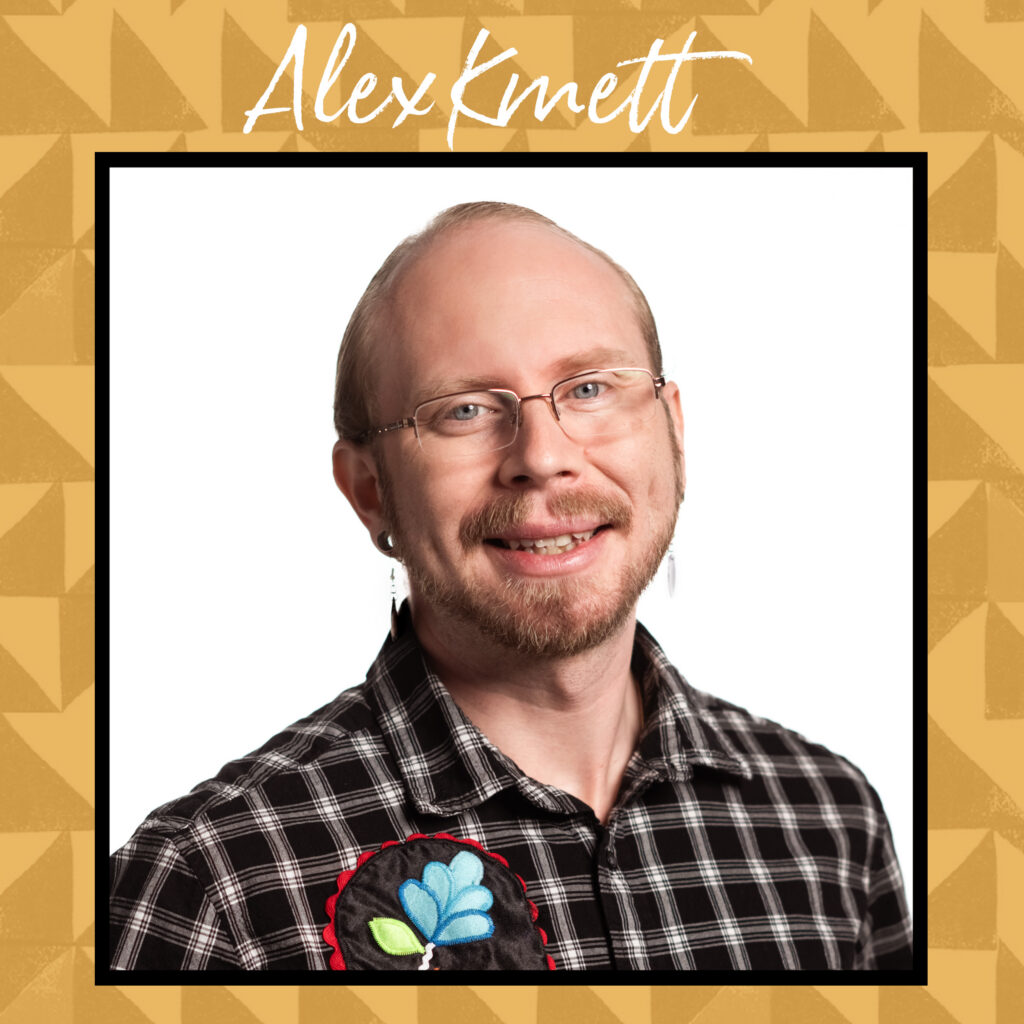
Today, we’re speaking with language revitalization leader and cultural educator Alex Kmett. Alex is a citizen of the Red Lake Nation and a descendant of the Leech Lake Band of Ojibwe. He’s a 2026 Bush Fellow and a co-founder of a charter school in Red Lake Nation.
Alex says he was lucky to have grown up in the late 1980s and early 1990s, when there were more First Language speakers around. He soaked up their language and cadences. But he didn’t really have the opportunity to figure out the mechanics of Ojibwemowin until college and then, during immersive study with First Language speakers.
His passion for language revitalization extends to teaching, co-founding a school, and contributing to the online Ojibwe People’s Dictionary. In 2026, he was awarded a Bush Fellowship in recognition of this lifetime of work.
Alex shares why he thinks AI is not the answer to learning Ojibwemowin. He talks about bringing up his children in an immersive language environment, what it means to care for the Ojibwe language, and how to teach a new generation of speakers.
—–
Hosts / Producers: Leah Lemm, Cole Premo
Editor: Britt Aamodt
Editorial support: Emily Krumberger
Mixing & mastering: Chris Harwood
Native Lights is produced by Minnesota Native News and AMPERS with support from the Minnesota Arts and Cultural Heritage Fund.
—–
For the latest episode drops and updates, follow us on social media.
Never miss a beat. Sign up for our email list to receive news, updates and content releases from AMPERS. ampers.org/about-ampers/staytuned/
This show is made possible by community support. Due to cuts in federal funding, the community radio you love is at risk. Your support is needed now more than ever. Donate now to power the community programs you love: ampers.org/fund
TRANSCRIPT
[Music: Native Lights Theme]
ALEX KMETT: Eventually, I went to University of Minnesota Morris. They ended up hiring a first speaker from up in Canada. There was only about three students total. Sometimes I was the only student that would show up, so we would just the two of us would go for drives around the prairie, talk about what we see. I asked him to try to immerse me as much as possible, have our lunches together, have our coffees together, just spending as much time outside of class, learning as much language as I could.
LEAH LEMM: Boozhoo, hello, welcome to Native Lights, where Indigenous voices shine. I’m your host, Leah Lemm.
COLE PREMO: And I’m your other host Cole Premo. Miigwech for joining us today. Native Lights is a podcast and radio show, but it’s much more than that. At its core, it’s a place for Native folks to tell their stories. Each and every week, we have captivating conversations with great guests from a whole lot of different backgrounds. We’re talking musicians, artists, community leaders, language warriors-you name it. They have a wonderful mixture of passions, and we talk to them about their gifts and how they share their gifts with the community. And it centers around the big point of purpose in our lives, and let’s get going, Leah. How you doing? Let’s amplify some Native voices, huh?
LEAH LEMM: I’m doing well. How are you hanging in there?
COLE PREMO: Hanging in there. Yes, that’s the that’s the motto right now. But you know…
LEAH LEMM: Hanging from a like I don’t know…
COLE PREMO: Yeah, it’s that cat picture or whatever with…
LEAH LEMM: There it is. Yeah, exactly. Yeah, hanging on. Yeah. So I mean, there’s just so much going on that I feel like it’s always a nice time to take a moment to speak to some community members, hear how they’re doing, and hear some exciting, you know, like the movers and shakers out there, and hear how they’re doing and what they’re doing and why.
COLE PREMO: And why. There you go.
LEAH LEMM: So I’m really excited to talk to our guest today, Alex Kmett. Alex is a citizen of the Red Lake Nation and a descendant of the Leech Lake Band of Ojibwe. Alex is a 2026 Bush Fellow and co-founder of a charter school, and he’s a language revitalization leader, cultural educator. So, just a really cool like mix of stuff here. Can’t wait to dig into this conversation and hear more from him. Boozhoo, Alex.
COLE PREMO: Hello, thank you for joining us.
ALEX KMETT: Yeah, good to see you.
COLE PREMO: All right, boozhoo, Alex, could you start by please introducing yourself? You know, letting us know where you’re joining us from, all that good stuff?
ALEX KMETT: Hello, my relatives. My name is Alex Kamet. I come from the Eagle Clan at Red Lake. My family comes from the community of Obaashiing, Ponemah, as well as Cass Lake over at Leech Lake, and I’ve been living here at Fond du Lac Reservation for about 10 and a half years now.
COLE PREMO: How are you doing? How’s the family doing?
ALEX KMETT: Doing good, busy as always. Now that the school year started, we got the illnesses coming in and everything, and trying to stay healthy through the through the winter. So my daughter, she’s in second grade now. So I take her to immersion school about 25 miles away, I drive her there, drop her off, and then go pick her up. So it’s about 100 miles a day to keep my kid in immersion education.
LEAH LEMM: Wow, Alex, that is a commitment.
ALEX KMETT: Yeah.
LEAH LEMM: I will never complain again about driving my kid to like orchestra or something. But we like to start off our conversations by asking if there’s something that you’re concentrating on or thinking about these days that’s kind of top of mind.
ALEX KMETT: I was awarded the Bush Fellowship for the 2026 cohort, so I’ll be receiving some support from my own professional and leadership development over the next two years. Aside from that, I’ve been taking on a lot of like smaller, smaller contract work. So I’m working on an Ojibwe nutrition curriculum with John Hopkins Center for Indigenous Health’s Great Lakes Hub, and raising my children in Ojibwe language since each of them were born is easily a full-time job. And right now we’re in the middle of harvest season as well up here, so my family and I we take care of about an eighth acre plot. Ends up being several rows that go about 200 feet back. We’ve been bringing in a ton of vegetables and trying to take care of them and get them out to community members before they before they go bad.
LEAH LEMM: Wow, that’s great! So that’s a lot. Congratulations on the fellowship and all the cool work you’re doing.
COLE PREMO: You’re listening to Native Lights, where Indigenous voices shine. Native Lights is produced by Minnesota Native News and AMPERS with support from the Minnesota Arts and Cultural Heritage Fund. Today we’re speaking with Alex Kmett. Kmett is a citizen of the Red Lake Nation and a descendant of the Leech Lake Band of Ojibwe. He’s a 2026 Bush Fellow and co-founder of a charter school in Red Lake Nation. He’s a language revitalization leader and cultural educator, and a lot more. Let’s talk about the Bush Fellowship.
ALEX KMETT: Yeah, it belongs to the whole community. A lot of my work, I try to. I don’t center myself or my family or my own success. Success in language revitalization is a community effort. The Bush Fellowship, in and of itself, it’s a program that we all have to, well, those of us that were awarded it, we each apply for it. I believe there was almost 1200 applicants this year, and about 30 were selected in total. They prioritize people that have a track record of leadership within their individual areas of expertise, within their sector. I know what they had put on the website was they were calling back all the way to efforts that I had done when I was in undergraduate over 10 years ago. At this point, I didn’t really think it’s anything that’s even seems wholly relevant or impressive to anybody within my sector, personally. There’s a big misconception that I think a lot of a lot of us that were awarded it had that a lot of us didn’t quite realize until orientation. Most of us thought that there’s some kind of project base that the fellowship has to do with. Everybody had like you know their notebooks all full of project ideas and trying to pitch what they want to do and the Bush Foundation they told us if you’re doing anything that looks like work with the money that we award you we’re going to turn that budget around and tell you to rework it. We’re not here to fund your work. We already know that you do great work but we’re here to invest in you so that you can do your work better. Essentially, what that ends up looking like is professional development, coaching. Some people they use it to seek higher education. It can look like language maintenance, self-sustaining practices, anything that helps you be better at what it what it is that you do. I’m going to be taking a, there’s a small handful of conferences that I’m trying to attend that I haven’t been able to in the past due to price or not having the support to be able to go myself. Ones that I’ve been wanting to go to for at least 10 years now. Spending a lot of time with my own mentors that I’ve been working with over the years. I’ve heard a lot of the Bush fellows say that it’s almost like winning the lottery with time. So we have the time to be able to just really focus in on working on ourselves but also spending time with our family and just being present within our community as well. And for me, in particular, that’s a huge one. Raising my children in Ojibwe language is extremely time intensive, although I had helped to co-found an early childhood education language nest, some of the staffing and support has kind of fallen off with some of that as well. So my son doesn’t have the same type of programmatic support that his older sister had at this point. So right now I’m also just kind of doing like at-home preschool for my youngest, and I I wouldn’t be able to do that otherwise. When you’re raising them in languages other than English, they need that support at home. They need a linguistic community. Just really need to take the time to be able to support that type of development for them.
LEAH LEMM: That’s so wonderful, Alex. The gift of time.
ALEX KMETT: Yeah.
LEAH LEMM: It’s easy to take it for granted but then when you see the years fly by, let’s say, and you kind of realize how precious it is. Can you talk about getting into language, language revitalization, going back to when you first started learning. Can you tell us about that journey?
ALEX KMETT: That extends like all the way back to my childhood when I was growing up, because my family’s split between Red Lake and Leech Lake. I was exposed to quite a bit of language growing up, especially you know late ’80s, early ’90s, when there was more of it around in the community and everything. So I would hear it spoken more often. I didn’t really know how to break it down, how to express myself. So in my teenage years, that’s when I started getting a bit more serious about learning it. So we had the support through the Indian education programs in high school and everything. Later on, I did take an introductory course with Rick Gresczyk at Minneapolis Community Technical College (MCTC) but that’s going back to 2005. So I didn’t have the money to keep going to school at that point. So I had to wait a few more years. Eventually, I went to University of Minnesota Morris, and we didn’t have Ojibwe language there at that point, but we had started a language table to just pool knowledge. Anybody that had any type of language knowledge would bring that to the table, and we would just teach one another. Then the following semester, they ended up hiring Gabe Desrosiers, who was a First Language speaker from up in Canada around the Border Lake, Lake of the woods area. So when it came to second year of classes over there, there was only about three students total, myself included. Sometimes I was the only student that would show up, so we would just the two of us would go for drives around the prairie, talk about what we see. I asked him to try to immerse me as much as possible, have our lunches together, have our coffees together, just spending as much time outside of class, learning as much language as I could. It’s a really rare thing to be able to learn from first speakers, especially as time is going on. Later on, I ended up going to Ojibwemotaadidaa Omaa Gidakiiminaang Immersion Academy here at Fond du Lac. That was 2014, and I got hired up that fall, and spent about eight years working there, interviewing first language speakers, working on the recording for the Ojibwe People’s Dictionary, creating multimedia curriculum, trying to spearhead a program to be able to distribute that curriculum as well, so that it can be more accessible for people all over the place, and building up the type of resources that we didn’t have when I was getting started. Now it’s a much more cohesive environment for language learning. I feel like there’s so many more opportunities available, so many more resources, books, classes, second language speakers, just to be able to speak with. For the longest time, I didn’t have anybody I could speak with beyond just first language speakers. Now, every couple days, I’ll run into somebody at least, and we can have a conversation. Whether it’s at the grocery store, language and cultural center here at Fond du Lac. The tribal college also recently got their Bush grant as well. So they’re expanding a bunch of their language offerings and hiring up a bunch of people over there. The tribe itself also has four language learners that they’re supporting right now too. So, just trying to do what we can to build more adult speakers that we need to fill all these roles in terms of people that can teach out in the community.
LEAH LEMM: Wonderful. You said you recorded for the Ojibwe online dictionary.
ALEX KMETT: Yes.
LEAH LEMM: This is such a great resource. I use that all the time to just hear pronunciations and look everything up that I can.
COLE PREMO: You were recording elder first speakers, correct? With that, what did you learn from those sessions, and you know the responsibility that comes with holding those voices?
ALEX KMETT: Well, I learned a lot about the process of how you go about doing those types of recording sessions. Like I, I already had some background as a musician myself, going into audio tracks and being able to cut them up and edit them and everything. I knew how to engineer a recording session already, so I was stepping in with that type of background knowledge. But at the time, I didn’t really have some of the deeper understanding of the language, the way some of the words break down. I guess we would call that morphosyntax. Even just knowing where some of the words would break in between, there’s a certain flow that you’ll hear out of first language speakers, that’s kind of different from when you’re hearing second language speakers until they get to a certain point where they start to refine their speech. I guess you could call it like a like a second language speaker accent. With the first language speakers, they have a certain flow to it. Like it’ll start out a little bit higher, and as it goes, like it glides and gets a little bit lower in tone until they take a breath, start back at the top again, and make their way down. And it’s just got that certain flow and that certain cadence to it. When you spend like hours upon hours in it with it in headphones, and you have to go for a accuracy trying to type it all out and everything, you start to really lock into that flow and understand where all those breaks are. We would also submit all of our recordings to John Nichols. He was the one that coordinated for the dictionary and everything. So we were recording for our own curricular projects, and we were doubling up those efforts to contribute them to the dictionary as well, and then he would also send back his feedback and his edits and everything, and then we go and edit our files, edit all of our transcriptions, and you just get better and better the more you do it.
LEAH LEMM: Alex, I know what you’re talking about with that flow. Is there any way to communicate that while writing it down?
ALEX KMETT: Um, it’s hard to say. I I suppose you could even like maybe move it to another line, or you could just like make a small like a hash mark in your in your running notes. It’s hard to catch exactly because also when you go in and with our best practices with recording, we would go back with the elders again and ask them like, okay, now how would you translate this? Because you know, we might know how we translate it into English, how we understand as you know second language speakers, or how we might communicate it. But when the elders will take it, they might put it into slightly different terms or worded a slightly different way. You catch a lot more nuance, and exactly what they mean, rather than just trying to infer what they mean when you ask for the actual translation from them.
LEAH LEMM: The other thing that you know I notice just hearing First speakers talk is there’s like a resonance, certain kind of resonance in throughout the body. Perhaps that kind of like is just a different way than we speak in English. We’re very like up here, I feel like with English, but then like when I hear like Ojibwemowin spoken, it feels like it’s a more full body activity.
ALEX KMETT: I feel like where we produce some of the sounds from is a bit different. Like in English, like you say, it’s very much like in your mouth. But in Ojibwe, we have kind of in our nasal cavity almost. There’s like resonance that happens right there, and that’s where we start to hit a lot of these nasal vowels and everything that we don’t quite have in English. My daughter, she can do it great. You can hear it just buzzing back there. So, so that’s something that I notice. It takes early learners a little while to catch on to. It isn’t communicated in writing very well. So my we’eh, he was the late [Name?]. I remember him talking about the way people would write that nasal n. So, for instance, in the word mawinzo, he said everybody would just pronounce it way too hard, and it would sound like mawenzo. He’s like mawinzo. You get that mawinzo, like a nasal z in there. So I remember he would just get so angry, even when he would see the nasal end written. He would go and just wipe it right off the board.
LEAH LEMM: Is there anybody working on maybe like an updated alphabet or something to like communicate those specifics a little more?
ALEX KMETT: I haven’t heard of any myself. The double vowel system isn’t perfect by any means, especially for second language learners. Well, I know first language speakers particularly tended to have some of the issues with how it looks and being a little less intuitive. But I know for second language adult learners in particular, it’s at least standardized to a point where they can kind of grasp certain concepts, and although it’s not perfect, they can kind of work their way through it over time. Yeah, I haven’t quite heard of anybody working on a new one.
LEAH LEMM: Okay, I imagine that you learned a few jokes.
ALEX KMETT: Trying to think of one that’s appropriate. You learn a lot of things sitting with these elders, you know.
LEAH LEMM: Like the different sort of like humor that comes out with the language versus English. Is there something that you learned from humor?
ALEX KMETT: I’m not the greatest at recalling jokes from memory, but there’s one I heard from my buddy from Canada. [Speaks Ojibwemowin]. What did the guy who fell and broke his leg say? Oh my god, or oh nikaad. So it’s like a play on oh my god, but it’s like oh my leg, you know. Occasionally, I’ve managed to find, you know, you’ve heard of like double entendre where something has a double meaning within language. I’ve managed to find a couple triple entendres on occasion, but they’re rare, and I haven’t marked them down. And I’ve got them in one of probably 20 notebooks, you know. And we always hear that it’s funnier in the language, you know. But I think in general, the language itself communicates so much more than we can in English. There’s just so much more nuance and deeper meaning. In particular, like when I think about morphosyntax, or our morphemes are each little sound that’s maybe one or two syllables, and each of those will carry meaning. So, like literally, almost every breath put to sound communicates meaning. So, although our words will be pretty long and descriptive, if you know what those little bits are and how they recombine, you can start to understand the language. You can start to understand words before you’ve actually ever heard them before. Like you hear a new word and you’re like, oh, I understand that based off the context and based off of the bits and pieces. And I suppose we can do that in English too. You know, if you start to if you start to get down like your Greek and Latin word parts and everything, you know, so many of us we know like hex would have to do with like the number six for like say hexadecimal, etc.
LEAH LEMM: You’re listening to Native Lights, where Indigenous voices shine. Native Lights is produced by Minnesota Native News and AMPERS, with support from the Minnesota Arts and Cultural Heritage Fund. Today, we’re speaking with Alex Kmett. Alex is a citizen of the Red Lake Nation and a descendant of the Leech Lake Band of Ojibwe. He’s a 2026 Bush Fellow and a co-founder of a charter school out in Red Lake. And Alex is a language revitalization leader and cultural educator.
COLE PREMO: So let’s dig into the charter school that you co-founded on Red Lake Nation. Could you tell us about how it came about and the mission behind it?
ALEX KMETT: Actually, during the pandemic, my buddy gave me a call and he asked if, like, I was just wrapping up my Master’s of Indigenous Education at Arizona State University, and I just got in a call asking, “We want to get this school started. Would you come and meet with us? Like, we’re trying to get this board going.” And it’s like, he’s trying to ask me, like, to be on the board, or are you trying to ask me to provide some context, or or or where are we going here? The answer was just yes. So we got started. It happened a bit quicker than I had hoped. Essentially, we were having a lot of these discussions around if we were to create like an indigenized form of education and start our school. What do we really want it to look like? And a lot of the ideas that we’re coming up with was essentially having our culture be like this multifaceted curriculum, where essentially we’re living in our own lifeways, doing everything that we can outdoors. So we’re doing land-based learning, using our culture as the curriculum, and trying to use our language as the medium, and we kind of went back and forth a bit whether we wanted it to be an immersion school or not right off the bat. Because starting K through five right off the bat, that’s kind of hard to start an immersion school, you know. So you have to transition some people in. Like what happens when you’re having people that are transferring over? So things get a little bit messy at times, but of course, starting anything from scratch with language, you know, we have to build up all of those resources from scratch. Those are some of the lessons that we learned from places like Niigaane and Waadookodaading. One of my biggest influences when I was getting started, was I had seen that First Speaker’s documentary on PBS, and I saw Leslie Harper and Adrian Liberty and how they got the Niigaane School going and how they’re raising their child in the language, and I knew it was extremely difficult, but it really pushed me to kind of do something similar. Just knowing that there’s resources that are available. We’re creating these this infrastructure to be able to take our language back, trying to pursue similar types of similar types of paths there. So yeah, with the school, we opened in September 2022, I believe. We had a couple modular, well, a single modular building over in Red Lake. Later on, with some of the CARES Act funds that were coming through, and I believe some there was some help from Shakopee as well, we established a permanent building just southeast of where that modular was. And it’s just basically right around the corner from the St. Mary’s Mission School as well. So there’s this interesting kind of juxtaposition there when we think of the history that the mission had regarding our language and culture, and that we’re right here bringing it back as well. And literally, our schoolyards were right up against one another, even using some of the playground facilities as well, sharing some of the same for a while.
COLE PREMO: So what informed like the curriculum that you present in the charter school?
ALEX KMETT: With my curriculum that I develop in general, I try to ground within these notions of relationality and reciprocity. When we’re considering relationality, we’re thinking about everything that’s out there in existence that we’re interrelated to. So we’re connected to our water. We’re connected to our land, all the plants, the animals, the air. Every action that we take affects our neighbors. It affects our future generations. We’re impacted also by things that have happened in the past. So it extends across time, across space, across everything that we have in our environment, then when we consider reciprocity at the most basic level, this would be like our tobacco offerings. There’s nothing that we can take without giving back as well, and that goes into even when we get into like hunting teachings as well. Oftentimes, there’s particular organs or parts that may go back into the woods, or hung in a tree, or buried, put back in the water, etc. But all that is tied to everything else that we’re related to as well. So, when we try to consider those impacts in this cultural sense, we can apply it to basically our entire way of life, our food systems, everything that we are given as Anihinaabe people, but also in our interactions with one another as well, making sure that we’re treating one another with respect, making sure that you’re not just constantly asking something of some somebody, but you’re also helping them as well. It’s a concept that I believe if we. Applied to our everyday life, then we get into these concepts of mindfulness. We become more observant of the world around us, not just like our neighbors and everything, but like even taking a look at the weather, you know. And then that starts to feed into our language as well. We’ve got how many different words for rain, you know, it’s not just gimiwan, but we’ve got this whole gamut of words that end in -biisaa as well. Is the rain coming? Is it going? Is it stopping? Is it intermittent? Small drops, big drops. Is it purple? So when you take that time to be observant as well, you can communicate so much more in the language, and you can think about all these different ways that you can put it. And it’s so much more conducive for language learning, for interacting with one another in our environment. And it’s just something that I try to ground our entire theory of education within.
LEAH LEMM: I’m just curious about your perspective on AI, you know, the introduction of AI into language learning.
ALEX KMETT: I’ve been deeply skeptical of it. I tend to look back all the way back to World War II and the way that our languages were used as essentially unbreakable codes, and that speaks to the difficulty and the complexity of our languages. But I think also there’s an aspect of security there, and like our languages got us through, and I think they should be respected in that regard as well. And that we may need to rely on them in the future. If you take care of the language, the language will take care of you. I don’t think that AI is necessarily a way that we’re really taking care of our language. I know I’ve seen some people that have tried to say use ChatGPT to teach themselves language. Eventually, I started figuring out, oh, people are doing this through AI, kind of like AI slop gibberish. AI isn’t going to learn our language for us. If we’re going to be speakers, we need to take that time to learn it ourselves. So for me, with language learning, one of the biggest things that was helpful for me over the years was just diving into full immersion, taking time with First Speakers, and just telling them to immerse you. Just remember that immersion is a teaching method. It’s not a skill level. If you’re working with a skilled immersion educator, they can take you on from day one. So it’s just another method of learning and teaching.
[Music: Native Lights Theme]
LEAH LEMM: All right, Alex Kmett.
COLE PREMO: Yeah.
LEAH LEMM: Doing great work in language. On a Bush fellow. Gosh, you could really tell his knowledge is wide and deep.
COLE PREMO: Yeah.
LEAH LEMM: Very very cool person.
COLE PREMO: Yeah, yeah. So miigwech to our guest Alex Kmett. I’m Cole Premo.
LEAH LEMM: And I’m Leah Lemm. Miigwech for listening. Giga-waabamin.
COLE PREMO: Giga-waabamin.
LEAH LEMM:You’re listening to Native Lights, where Indigenous voices shine. Native Lights is produced by Minnesota Native News and AMPERS with support from the Minnesota Arts and Cultural Heritage Fund.
Subscribe to Native Lights wherever you get your podcasts


More from Native Lights
- Alex Kmett: Culture as Curriculum, Language as Medium
 Today, we’re speaking with language revitalization leader and cultural educator Alex Kmett. Alex is a citizen of the Red Lake Nation and a descendant of the Leech Lake Band of Ojibwe. He’s a 2026 Bush Fellow and a co-founder of a charter school in Red Lake Nation.
 - Ryan Dixon: Making Friends with the Dakota Language
 Today, we’re speaking with Ryan Dixon. Ryan is an enrolled member of the Oglala Lakota Tribe from Pine Ridge in South Dakota and has spent over two decades immersed in the Lower Sioux community in southern Minnesota. He trained under First Language Dakota speakers, and he now teaches Dakota. An educator and Indigenous language activist, he co-founded a Dakota Immersion Head Start programming and works to keep the language alive for future generations.
 - Michael Kurtz: Tales of a Wildlife Photographer
 Our guest today is a photographer who takes some stunning photos of wildlife. We’re very excited to speak with Michael Kurtz (Tasunka Opi). He’s Sicangu Lakota, enrolled in the Lower Brule Sioux Tribe. He runs Lakota Photography, blending wildlife photography, tracking, and cultural education. He’s also a naturalist and has volunteered with groups like the National Park Service and Project Coyote. He has spent countless hours across the Dakotas, Minnesota, and beyond, capturing wildlife in its natural habitat. Currently, he’s supervisor of programming and interpretation with Hoċokata Ṫi Cultural Center at the Shakopee Mdewakanton Sioux community.
 MNN Extended Interview: Bryan Bosto